
In Ohio, the combination of drought and the current cyanobacteria blue-green algal bloom in the Sandusky Bay could result in fish kills, but favorable fall weather is likely to arrive […]

Despite low river levels and summer heat, the Michigan DNR’s annual fish egg collection at the Little Manistee Weir in Manistee County saw strong returns this season, a welcome sign […]
Despite worries over rising temperatures, it turns out anglers have a greater effect on fish populations than climate change. Read the full story by Wisconsin Public Radio.
The Huron River winds through woods in Ypsilanti Township, Michigan, where thousands of residents fish, canoe and swim. A proposal aims to add a 300,000-square-foot data center with a 20-acre […]
By Isabella Figueroa Nogueira
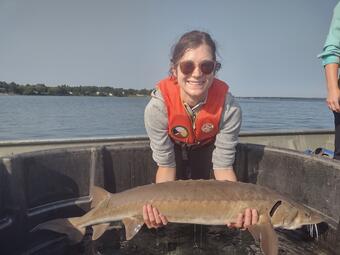
A recent collaborative study, conducted through the Great Lakes Indian Fish and Wildlife Commission, the College of Menominee Nation in Kenosha, Wisconsin, nine tribal entities and academic researchers to understand how climate change threatens the lake sturgeon and to develop adaptation strategies rooted in tribal knowledge.
Hundreds of people gathered at Rivergate Park in Cleveland, Ohio, to contribute to an ongoing effort to re-introduce sturgeon to Lake Erie and its surrounding rivers. Read the full story […]
The Ohio Department of Natural Resources will release 2,000 fingerling sturgeon into the Cuyahoga River, hoping that in 15 to 20 years they will come back to reproduce. The goal […]
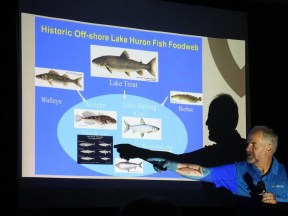
The first meeting of the 2025-2026 season of the Huron Bruce Nature (HBN) club went swimmingly with an excellent presentation on the changing ecology of Lake Huron fish communities by Ministry of Natural Resources and Forestry Management biologist Arunas Liskaukas. Nearing retirement after a 35-year “dream” career researching and working with fish, this passionate scientist […]

A $330,000 grant has been bestowed upon the University of Wisconsin-Green Bay in order to study the impact of microplastics on aquatic life in Lake Michigan. A team will collect […]
As whitefish disappear from the lower Great Lakes, scientists are hatching emergency rescue plans. One idea being floated is to take fish out of the lakes and raise them indefinitely […]
By Donté Smith
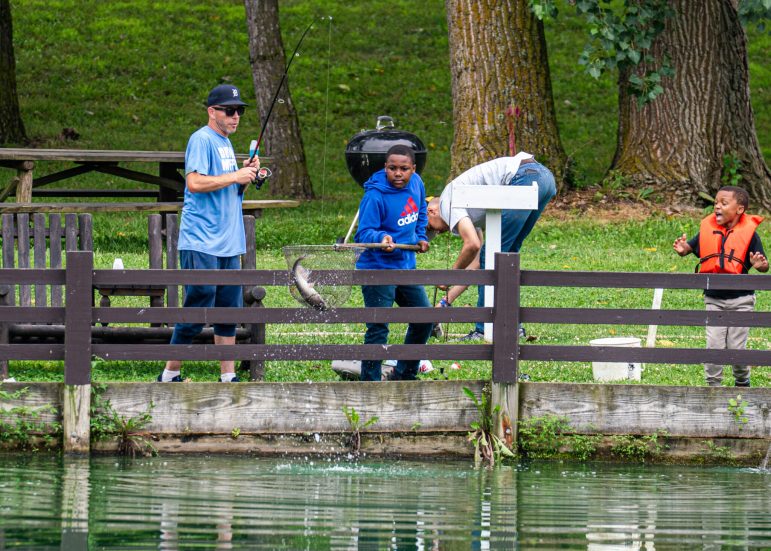
Despite being surrounded by the largest group of freshwater lakes on Earth, Michigan imports the vast majority of its seafood, between 65% and 90%, according to Michigan Sea Grant. As global aquaculture has grown to meet increasing demand for protein, a small but determined group of inland fish farmers in the Great Lakes region are building a more sustainable, local supply. Researchers say doing so could ease pressure on wild populations, create jobs in rural areas and help restore public trust in the food on their plates. But with high regulatory costs, limited consumer awareness and strong competition from imports, these farms face an uphill swim.
The post How inland fish farmers cultivate a sustainable future for the Great Lakes first appeared on Great Lakes Echo.
The Pennsylvania Steelhead Association is looking for anglers to report catches that include a Shasta rainbow trout. The organization is hopeful anglers will find Shasta rainbow trout that were stocked two years […]